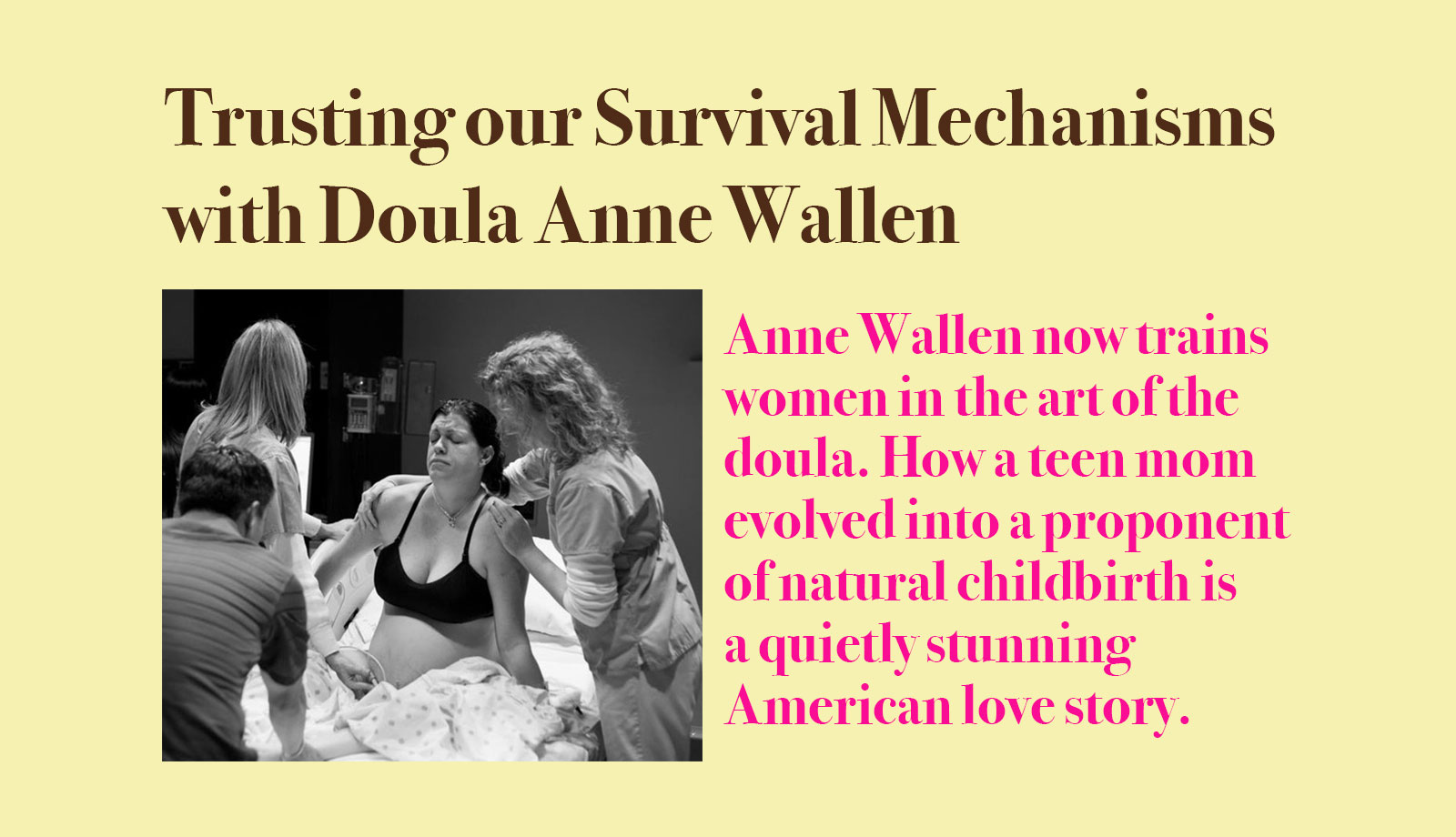
It’s not often that you get a chance to thoroughly embarrass yourself on your own podcast. But host Suki Wessling was up for the challenge! Anne Wallen is an experienced doula and doula trainer, the mother of six, and someone for whom birth is a natural process, a beautiful experience, and the love of her life. When Suki tries to tell Anne what’s what in this frank and insightful conversation, Anne—nicely—sets her straight.
American women are so entrenched in our system of birth that it’s hard to see other possibilities, but Anne and the women she works with and trains are evangelical about how different it could be. In this conversation, Anne explores the ‘typical’ doctor-led birth, then describes the births she assists. The contrasts could not be more striking. Anne points out that the American way of birth is a process built on taking away women’s bodily autonomy.
[Click for transcript]
“American women are not seen as equal. We’re seen as under, we’re seen as adjunct, we’re seen as property. And so oftentimes, when we’re talking about healthcare, we have this kind of nuanced belief that we can’t trust a woman’s body.”
Finally, we explore Anne’s own life, starting with her first birth at 17, and she reveals a life that is truly a stunning American tale.
“If left undisturbed birth will happen, just like any other natural biological process. When there’s issues, thank goodness we have the ability to help those who need a little extra help. But when we interject that help without it being necessary, now we’re just asking for trouble.”
Anne Wallen, Director of MaternityWise, International, Mother of 6, grandmother of 2, has always found herself in maternal caregiving roles for the past 33 years. She currently helps write curriculum and is the director of MaternityWise, an international certifying body for doulas, lactation support people and childbirth educators among the many exciting skill trainings offered.
Trusting our Survival Mechanisms with Doula Anne Wallen
[00:00:00]
[00:00:27] Anne Wallen: I was raised by women who, I don’t want to call them feminists because I don’t think any of them would consider themselves feminists, but they really understood nature and just mothering and trusted and believed in the body.
[00:00:43] Voiceover: This is your host, Suki Wessling. When this month’s guest describes the sort of childbirth she facilitates, I’d hazard a guess that most American women won’t even recognize what she’s talking about, and that includes me. I had the fullest intention of experiencing natural childbirth, but the minute my first birth started, things went, well, exactly as Anne will describe during this conversation.
[00:01:08] Anne Wallen: Hi, I’m Anne Wallen and I am the director of Maternity Wise International. I am the mom of six and the grandmom of two, and I’ve been finding myself in maternal care roles for the past 30 plus years. And now at this point I am teaching doulas, childbirth educators, lactation support people, and I just really love this whole area of maternal care. It’s really my, my passion.
[00:01:34] Voiceover: Listening to Anne describe the American way of birth, I have felt like Roberta Flack strum in my pain with her fingers. S singing my life with her words. American women are caught in a system that makes false promises, catches them in a web of confusing jargon at their moments of greatest vulnerability, and then takes away their bodily autonomy.
[00:01:58] But there’s hope and Anne’s here to tell you about it. She’s a doula who trains doulas, women whose job it is to help before, during, and after birth in non-medical support and interventions. For those of you who have given birth in our system and think it went okay, Anne’s going to poke a few sore spots.
[00:02:16] She certainly did for me. But her message of evidence-based hope for people who give birth in this country is an important one, and her own story of being nurtured by women is a quiet but stunning American tale.
[00:02:29] I started the conversation relating where I stood on the question of whether humans know instinctively how to give birth and Anne promptly disabused me, nicely, of all that I believed. I do love gaining new perspectives from my guests, and I hope you do, too. Despite the pain the Anne will strum for us in this first segment, get ready to hear a beautiful vision of how American birth could be, no matter what your preconceived notions might be.
Does the human body know how to give birth?
[00:02:59] Suki Wessling: I grew up in a household where we, we always had cats and it was the sixties and seventies, and our cats were never spayed and thus we always had kittens. And the process for all other animals on earth of giving birth seems to be pretty darn easy. Um, they don’t cats, cats in, in particular ’cause the, they’re the ones I know the best. They, they don’t nurture each other. Mother cats don’t teach their daughters once their daughters are of childbirth age, how to give birth and how to nurse and everything. Everything’s done by instinct. And
[00:03:38] there’s this old fashioned idea that, that women should just instinctually know how to be mothers.
[00:03:45] And there’s a whole, I guess thread in the natural childbirth movement that we do know that. But the fact is that human bodies are not like other animals’ bodies, and our social arrangements, our social relationships are not like other animals, and perhaps our instincts aren’t. So could you talk a little bit about why we even need something like a doula?
[00:04:12] Anne Wallen: I believe is that our bodies do have that innate wisdom in how to do this process. We have the organs, we have the muscles, we have the bony structure, everything that supports childbirth, right? Our, our pelvis, for example, is a three piece hinged unit, and it can move and change shape and enlarge and allow the baby to move through it.
[00:04:36] Our muscles, our, our brain chemistry that promotes oxytocin, that creates the contractions. You know, all of these things know how to work together. Just like our breathing, we know how to breathe. We don’t have to think about it. We don’t usually need assistance with it unless there’s something going wrong.
[00:04:54] Our digestion, like our, we don’t have to think about our digestion. We just eat our food and our digestion does its thing and we go to the bathroom and, you know, hunky dory. Sometimes our, our biological functioning doesn’t go perfectly. One of the obstacles that we face as far as our just natural bodies’ processes, one of the functions, um or one of the requirements for these functions to work, right, is the ability to be vulnerable and the ability to feel safe. So I like to explain it to my students. It’s kind of like orgasm. In fact, it’s very, very much like orgasm because the same chemicals are at play. And if you’re in a room with strangers with bright lights shining down on you and it’s a fam unfamiliar space, um, you might not feel comfortable having an orgasm.
[00:05:49] It might be very, very difficult. You can force it maybe, right. But it’s a, it’s not just a biological process in our body, it’s also in our mind. It’s in our brain. And so if we don’t feel safe and comfortable to open up the sphincter of our cervix right, and we don’t have control over that, this is an involuntary process, right?
[00:06:11] But the whole birth process, the pregnancy process, all of this has these really amazing, I call ’em survival mechanisms. And when I’m training, you’ll, my students probably get tired of me, but I sing song it, I’m always like, here’s another survival mechanism I love them. There’s so many of them.
[00:06:31] And it’s just so exciting to me to be able to see like, you know, so for example, you walk into a hospital situation if you don’t know the doctor or if you’re feeling negative vibes from the doctor, or if you’re feeling pressured or if you’re, you know, feeling at all like you’re not safe. And this could also be on a very subconscious level.
[00:06:49] Your body reads all of that and your body says the environment outside of where baby is right now is not a safe place to bring the baby. And so we’re gonna just shut this process down until we feel safe. And you see that, you do see that in animals as well. So let’s say there’s, you know, a mama kitten having her babies, and then there’s some kind of threat that comes along that mama will stop having her babies.
[00:07:17] She’ll pick up the ones she’s given birth to bring them to a safe place. And once she’s got everybody in the new nest, right, she continues to have the rest of the babies. And so this is a, a survival mechanism that we love to appreciate. But it also is hard to get around if you are having to go to a place that doesn’t feel safe to you, doesn’t feel familiar to you having to be around people who don’t, you know, they’re not familiar.
[00:07:45] Or sometimes it’s the first time you’ve ever met this person and then they’re supposed to be up in your junk? No way. Like you can’t feel good about that, right? Even if you know with your mind that this is quote unquote normal, which it’s not normal at all, but we’ve, we’ve created this expectation of it being normal.
[00:08:07] Now, you know, birth has always, for the majority always happened in homes when there was trouble, they went to a place that could provide the skills and the tech and the whatever necessary. But for the most part, you know, if, if left undisturbed birth will happen, just like any other natural biological process, and when there’s issues, thank goodness we have the ability to help those who need a little extra help.
[00:08:37] But when we interject that help without it being necessary, now we’re just asking for trouble and, and on a, in a, in a way that, you know, the birthing person can’t control. So. It’s, it becomes this kind of catch 22 where they’re trying to do the right thing. They might be really fearful of birth ’cause we’ve been taught to be fearful of birth.
[00:09:01] Um, but that backfires. And sometimes it’s that self-fulfilling prophecy where it didn’t have to go poorly, but because you’re expecting it to go poorly because you’re behaving in a way and, and putting yourself and your body in a situation where you’re expecting it to go poorly. It, it does. And so then you end up needing help. Whereas if you just believed in yourself and your ability and stayed in a place where you’re safe, it might just unfold very easily.
Home birth
[00:09:31] Suki Wessling: So would you say that you’re a strong advocate for home birth for everyone? Or what do you think would be the best way for us from a public health standpoint to set up a system that sets up the environment that you are talking about?
[00:09:48] Anne Wallen: So that’s a little tricky of a question, but me personally, I’ve had three hospital births and three home births, and my three home births were wonderful. My first two hospital births were also wonderful, but I had a caregiver who was much more like a midwife than an ob. Um, and was very trusting in my body.
[00:10:12] And so I just also, you know, her, her vibe, her belief, and my ability to give birth rubbed off on me in that. That was how I saw it as well. And I was young, so I didn’t know any better, but when I’m talking from a public health standpoint, we need to look at what the rest of the world is doing. It can’t just be, um, you know, America needs to do this or America needs to do that, or America’s better at this or that.
[00:10:38] But our, our maternal mortality rate continues to climb when the rest of the world is declining. Like their, their mamas are not dying in, in birth and ours are at a increasing rate, which that’s just inexcusable considering that we’re so sure that we know how to do this right. You know, and I would say that with a skilled provider, and by that I mean a midwife that knows what she’s doing, right?
[00:11:06] If you’re at home, that is probably the safer place to be. And when you look at other countries, most of the countries that have the best rates, they have midwife led care, and a majority, well, I shouldn’t say a majority, but a larger percentage of births that are happening at home in America. We have a declining rate of women who are giving birth at home, and also an increasing rate of maternal mortality. So to me, that kind of spells out where we’re doing this and how we’re doing it isn’t working, right? And so we need to get back to understanding women’s physiology. And I think that that also comes from, you know, in a, in a hospital setting, there’s a lot of male or masculine, uh, solutions or processes put on a feminine process, which doesn’t work.
[00:12:01] It’s a, it’s a, it’s a, you know, circle trying to fit or in a square peg or a square peg in a square, in a circle, whatever. It’s, it’s just not compatible with how women, physiologically and psychologically, need to go through the process.
[00:12:27] Voiceover: You are listening to the Babblery’s interview with doula Anne Wallen. Anne mentions the rising American maternal mortality rate, which is a standout in the world of women’s health. The wrong kind of standout, but although I know the statistics, I felt I had to push back on the idea that all Americans could experience the beauty and safety of home birth. When you pick apart the birth data, you find an extremely strong correlation between higher maternal mortality rates and socioeconomic status. It’s clear that women without resources and support fare worse. So I asked Anne to address the women who don’t have a village of support around them, and to contrast midwife led birth with a typical hospital birth.
The American way of birth: Birthing center vs. hospital births STOPPED HERE – delete previous
[00:13:14] Suki Wessling: at a, When you’re doing a home birth, the midwife typically is her, and she’ll bring an assistant and then you, a lot of times we’ll also have a doula.
[00:13:23] Anne Wallen: So in that way you do have this little mini village around you, and they’re all specifically trained in how to support you. Um, in a birth center, you’re going to have sort of the same environment, right? Um, a homey environment with certain tech and certain things that are available there that you wouldn’t necessarily have a midwife carting out to your house.
[00:13:49] But, um, it still feels a little more friendly, so it still feels a little more safe. And the, the birthing person has probably gone to the birth center multiple times for their clinical appointments, so they’re familiar with the environment. Walking into a hospital setting is different from that because we we’re not familiar.
[00:14:09] Usually we don’t spend time in those birthing suites like ever. Right? So it’s a completely unfamiliar environment. And then there’s unfamiliar people, but you’re still having those, you know, different attendants. So you’ll have your OB or midwife in a hospital setting. You’re gonna have your nurse when you’re pushing some extra people come in.
[00:14:28] So you have your your pediatrician or pediatric nurse that will come in, sometimes an additional labor nurse will come in. Um, but in a, in a hospital setting, if you have a doula with you, she’s that one person you’re familiar with. So she’s bringing that familiarity. And sometimes if you have a, a situation where, you know, like let’s say you plan a home birth, you’re low risk your whole pregnancy, and then at some point, oh, something happens.
[00:14:56] You’ve developed some issue that creates, you know, this high risk category now. So being able to go into the hospital where you get the things you need, but you still have your team with you is very, very reassuring. Um, and that does provide safety for the mom, both, both just in a, in a real physiological sense, but also in a psychological sense.
[00:15:20] Um, many of the things we do to women in labor. Create complications, which then necessitate additional interventions, which then create more complications, which necessitate additional, you know, interventions. So let’s just take your average hospital birth. You go in your in triage, you’re usually, um, separated from your partner.
[00:15:45] One of the reasons why they do that is because they want to make sure that they can ask the birthing person questions that they feel comfortable answering. So if I’m, if I’m with my partner and they ask me, do you feel safe at home? And he beats me at home, I’m not gonna say no in front of him, right? So they’re gonna separate you from your partner.
[00:16:04] So they’re can ask questions like that. They’re gonna ask questions about drug use, about sexual partners, about diseases that you may have, and they’re gonna do that away, you know, so that you’re on your own in an environment where you feel like you can have, you know, a private conversation about those things.
[00:16:19] Then they’ll admit you. If they decide that you’re ready to go, they’ll admit you to the hospital, you’ll go to your labor room. Then from there they’re going to do monitoring, and some of this they might do in triage too, but once you’re in the hospital, they’re gonna do monitoring, which typically is an ongoing thing.
[00:16:36] You really have to push to have intermittent monitoring, which means that they monitor for like 20 minutes and then let you off of it for the rest of the hour, and then you 20 minutes again. So you’ve got 20 minutes on, 40 minutes
[00:16:48] Suki Wessling: so people give, for people who haven’t given birth in a hospital, explain what the monitor is.
[00:16:53] Anne Wallen: Sure. So they have two paddles, kind of like these round paddles, and some hospitals have stickers, but for the most part, you’re gonna see these two little round paddles. One is an ultrasound that’s listening to the baby’s heart rate, and it’s gonna keep track of that on the computer screen, right? And then in addition to that, it’s going to be looking at your contraction pattern.
[00:17:14] So one of the paddles has this little tiny bump on the back, and it’s a pressure sensor, so when your stomach gets hard, it can, it shows the contraction as kind of like this, uh, like if you drew a roller coaster. So you’re gonna have like this up and then the down. And what they’re looking for is at the same exact time that these contractions are happening, what is the baby’s heart rate doing?
[00:17:35] What’s the baby’s heart rate doing right before as it peaks? After. And how is the baby’s heart rate resolving or not as you’re in these, you know, contractions? One of the downsides of monitoring is that sometimes it’s really difficult to keep baby on the monitor. So you might, or, or even to, or even to track the contractions.
[00:18:00] So sometimes you have nurses who are in there over and over and over again, and they’re having a really hard time getting this data, which for them, for a hospital, the data is everything. The data protects them in a lawsuit. The data gives them a heads up if there’s something to be concerned about. So the data is really the numbers, you know, and everything is really, really important for the hospital, um, from a business standpoint.
[00:18:26] Right. Not always necessarily for a care standpoint. But it does, it can clue you in if the baby’s having a hard time or it can clue you in if, if you are struggling to create strong enough contractions, they’ll be watching that and they’ll be saying, okay, well, you know, we don’t have contractions that we are gonna, you know, do this thing fast enough for our standards, and so we’re gonna give you something or do something to make them faster.
[00:18:54] This is where it kind of stops being care and starts being management.
[00:19:00] Voiceover: You are listening to the Babblery interview with doula Anne Wallen. Coming up, Anne will explain the distinction between care and management and then we’ll take a trip down memory lane and explore Anne’s own love story and the birth that set her on her path. When we return:
[00:19:23] Anne Wallen: She was more like a midwife than than a doctor, doctor, you know, not clinical, just really caring and gentle and, and had that trust, that my body would just do what it needed to do.
Segment 2: Birth as a love story
[00:20:14] Suki Wessling: This is your host, Suki Wessling. Anne Wallen is a doula who trains other doulas, and her wide experience of midwife led births has given her a particular point of view about what’s wrong with the American standard of care. But she says that even that phrase is misleading when it comes to birth. She starts here distinguishing medical care from medical management in a birth setting, but then we’ll leave management behind and hear a birthing love story.
From care to management
[00:20:43] Anne Wallen: When you’re talking about care, care is where you’re allowing the body to do its thing and you’re supporting, right? All along the way. Oh, your contractions are slowing down. Maybe you need a nap. Maybe you need fuel. Let’s support your body to give you what it needs to have in order to do the thing we’re, we’re watching for, or we’re, we’re expecting it to do.
[00:21:05] Management is where we say, oh, it’s not doing the thing we think it should be doing right now, or at the strength or at the, you know, frequency that we want it to be doing. Well, we’re gonna, we have medicine for that. We have a procedure for that. And so when you start to enter in these interventions, this management, that starts to create additional issues with the process, the biological process.
[00:21:30] So anytime you’re interfering in a biological process, you’re gonna have dysfunction. Right. And, and even if it’s a psychological dysfunction, it’s still dysfunction. Right. And so let’s take pushing for example. In a hospital setting, they have you laying in a certain way that is easiest for the doctor to view, to manage, to handle, you know, to do all the things. But it’s not physiologically good. It’s not physiologically easier. The back of your pelvis, you have this bony plate called your sacrum, and it goes from your lumbar spine to your coccyx, which is your tailbone. And it’s really like, kind of one big chunk of bone, right? It’s this bony plate, but it can move out and it can alter its angle, but when, when you’re laying on your back, you’re laying on the sacrum.
[00:22:19] And so if you’re laying on it, it’s really difficult for it to, it can’t really move, it can’t flex, it can’t alter its angle, it can’t, you know, press out of the way. So that makes pushing so much harder for moms. And so if I was in my bathroom, you know, having a bowel movement. I would not probably do very well if suddenly a group of people came in, they start cheering for me. They have great intentions, but they start cheering for me and they tell me, okay, take a deep breath, curl around that turd and push with all your might and hold your breath for 10 seconds and we’re gonna count in 1, 2, 3. You know that. And then they’re shining a light on me, right? And like that whole scenario is so crazy, right?
[00:23:12] And, but it’s this, but observational, you know, management, this active management where they’re, instead of just letting you get up and be in a position that your body would naturally be able to let your baby out, right? They want you in a, in, in a position, and they want you doing it in their way instead of just saying. All right, time to push your baby out. How do you want to be? Right?
[00:23:42] So, and then you have, if you back it up even further behind, you know, or earlier I should say, in the process, you might have an epidural. And so an epidural would necessitate that you stay in the bed because you can’t really, sometimes you can’t put weight on your legs.
[00:23:58] Sometimes you can, but we don’t want anybody falling, right? So we want to keep them in the bed. But there’s a lot of ways you can move that bed around and you, there’s a lot of ways you can position yourself in the bed that would allow you to have that different angle and allow the sacrum and allow the pelvis to move and change shape and open, um, and allow your pelvic floor to soften rather than, ’cause a lot of times people don’t really understand how to push.
[00:24:26] They’re, they’re squeezing so hard to get their baby out. They’re, they’re contracting and they’re squeezing everything. And what’s really happening is they’re squeezing their bottom rather than opening. And that opening and softening is really what has to happen.
[00:24:42] You know, women in a coma have given birth and they’re not consciously pushing. Nobody’s in there cheering them on. Baby just comes out and they figure it out eventually. But, and this has happened more than once, you know, so the body knows what to do. There’s something called a, a fetal ejection reflex. And the body will do it. You, you have all these contractions, contract, contract, contract, and those are all to open the cervix.
[00:25:06] And then once you get completely dilated and the cervix is around the biggest part of the baby’s head, and there’s really no more stretching that it needs to do, now the uterine muscles kind of gather up behind the baby. They kind of reorganize themselves. And you start to have this ejection reflex where the, the body actually pushes the baby down and out.
[00:25:28] Suki Wessling: Mm-hmm.
[00:25:28] Anne Wallen: And if you can just allow it to happen. I’ve watched women just breathe through their baby’s delivery. They didn’t push, they just breathed and their body did it for them. And when, when you’re able to just gently allow your body to do its thing, you don’t tear, you don’t have pelvic floor injuries as often, you don’t, you know, your body will do it slowly and gently.
[00:25:54] The the way that you would think that a baby would want to be born. Right. And the way that you would think a woman would want to let a baby out of her body. Right. So,
[00:26:05] Suki Wessling:
Anne’s love story
[00:26:05] Suki Wessling: You are so obviously just completely passionate about, and I mean, the way you talk about birth, it’s, it’s, it’s a love story. You know, how, how did this love story start? How did you meet this love?
[00:26:23] Anne Wallen: Wow. I’ve never had anyone ask me that question before. Um, that’s beautiful. You’re gonna make me cry. I, you know, I think I was raised by women who, I don’t want to call them feminists because I don’t think any of them would consider themselves feminists, but they really understood, nature and just mothering and trusted and believed in the body.
[00:26:50] And so for me, I was fortunate in, in that. And then my first couple of birth experiences were with a doctor that I had been with since I was 11. And she just, she was a gp, which they don’t really deliver babies anymore, but at the time, you know, she was my doctor and she was just so lovely and just so supportive.
[00:27:10] She was more like a midwife than than a doctor, doctor, you know, not clinical, just really caring and gentle and, and had that trust, that my body would just do what it needed to do. And I think that that really, especially for that first birth, it just wrote the story for me of what birth should be like.
The scary birth stories we tell
[00:27:30] Anne Wallen: But also I was eight and 10 when my brothers were born. And my mom’s way of telling the story, you know, was just that it, it works and it worked. And she had a, you know, easy time with both of them. And and in our communities, a lot of times the, the stories that get told are the scary ones.
[00:27:50] So back then , you know, this is 30 plus years ago, so we didn’t have the internet. I wasn’t reading other stories, like my exposure to what birth is was always probably very healthy, um, and positive. And so I just always believed in, you know, women’s ability. Now, moving forward, um, after working with so many people and being able to, it’s such an honor to be a witness to a woman’s amazing innate strength, it has convinced me over and over again that we know how to do this and we, we rarely need help.
[00:28:34] And then also if you think about the way that other countries do birth. So for example, in India, you know, women work really, really hard every other day of their life. But when they are pregnant, and then when they give birth, and then for at least 40 days afterward, they’re treated like absolute queens. They’re given massages and given special foods and, you know, really pampered the way that they should be, the way that we all should be. Um, and so over the years, as I’ve learned about the way that different cultures treat birthing people and birthing, you know, mothers afterward and breastfeeding mothers, and just the way that that all works and then also experiencing it in my own life I just really, I think that I just, deep down I know that it works and I have seen the power and forgive me for being so, uh, cliche maybe, but like the glory of that vaginal birth. Like that, that glorious those moments afterward, especially for a mom who has gone through, you know, maybe a traumatic birth the first time, whether it was a C-section or just a traumatic vaginal birth.
[00:29:48] And then having a birth where she’s respected and where she is, you know, allowed to be in charge and really just honored through the experience. And then the, that glorious, like victorious feeling that they come away with. And just being able to see that and see how it changes her as a human and how it changes her as a mother.
[00:30:12] And you know, in our society, women are still, unfortunately, still very undervalued, you know, in every aspect. And so when we’re looking at something like this where we should be able to just do what we gotta do and succeed at it, right? And then, and we’re still kind of put in these boxes that don’t, we don’t fit in.
[00:30:34] Yeah, I just feel really, really passionately about kind of just getting the, getting the boxes out of the whole system, right? Just like let us do what we have the ability to do.
A teen mom story with a very happy ending
[00:30:47] Voiceover: You’re listening to the Babblery’s interview with doula Ann Wallen. I described Anne’s story of how she found her profession as a love story. Like many good love stories, it has a beginning that could have ended in tragedy.
[00:31:01] Anne Wallen: My first baby was born when I was 17, so, um, when I was pregnant with her, I knew that I was not ready to be a mother. And I had very close friends that I had grown up with who had been trying to have a baby for some time. And she had actually babysat me when I was little. Um, they were our next door neighbors for as long as I could remember growing up, and I chose them to adopt her. But thankfully we had an open adoption and I was able to, you know, maintain a relationship. Although, you know, you’re not gonna infringe on their bond and, and that, but even, you know, as an adult, I consider myself close to her. I love her so, so much. And now just had her first baby and daddy brought a plus one, so I’ve got two, like what a, what a blessing, right? To have two little ones now as grand babies. Um, but, so that was, that was tough, but I’m very proud that that was the decision I made. And I would, I would do it again. I would make that same decision again.
[00:32:06] And when I had my 19-year-old, I was a single mom and I muddled through that, made my way through that. But I, but I kept that baby and went on to have, you know, more babies. And so I think too that that first birth. It was very painful to say goodbye to her in that moment of, you know, passing her off to mama. But I also knew, as far as my own self, I knew that it was the right ch, the right choice for me, but I also got to see how my body reacted and there is this very deep physiological longing. And so that also I feel like informed me for later. And how, and, and this is one of the reasons why I feel very, very strongly about, you know, not using Cry It Out methods and, and like to really, um, secure and protect a baby’s bond with their mother. Luckily, you know, Taylor has a wonderful relationship with her family and with us, and it’s, it’s this huge extended family.
[00:33:23] We just have so many extra parts that many families probably don’t have, but we’re lucky. I think we’re lucky to have them. Um, but understanding, um, those. You You know, we’re wired for connection. So understanding those feelings that you have when you hear your baby cry, or even when you hear somebody else’s baby cry.
[00:33:47] If you’ve ever breastfed a baby, you know what I’m talking about. You’re in target, you’re in the checkout lane and somebody’s newborn in the store somewhere is crying and all of a sudden you’re like, time to feed the baby. You know? ’cause your body will, it just, we’re wired to respond.
Do women have their own bodies?
[00:34:04] Suki Wessling: One of the unspoken things in what we’ve been talking about is what is done to women in our society that is not just part of our social structure, but part of a wider, to a certain extent, unintentional political agenda, which is taking away women’s bodily autonomy.
[00:34:29] we have
[00:34:30] Anne Wallen: have
[00:34:31] Suki Wessling: in our constitution this idea and our constitution was deeply informed by the Magna Carta, this idea of habeas corpus. You have your body, right, that, that in a just society, each person, then at the time of the Constitution, each man, has their body and that unless they do something transgressive we all have our body. And that is so deeply important in a democracy. And so legally, we’ve never actually included women in that, it’s not in the Constitution, but in our legal body, we have all of these decisions that have been trying to give women their bodies, but we don’t have them yet. Can you talk about that?
[00:35:26] Anne Wallen: oh, you want me to get there? Right.
[00:35:28] Okay. So unfortunately in American society and I, and in other places too, it comes down to I think a lot of, and I don’t want to blame religion, but I feel like a lot of it has a religion or religious base to why women are not seen as equal. We’re seen as under, we’re seen as adjunct, we’re seen as property.
[00:35:58] And so oftentimes when we’re talking about especially healthcare, we have this kind of nuanced belief that we can’t trust a woman’s body. And one of the psychological, ’cause this is, this is really gonna, well, we could really go down a rabbit hole with this, but one of the things that I, I see in medical practice and kind of in the whole, from pregnancy all the way through after, right?
[00:36:30] We, we have this psychological kind of manipulation going on where it’s like, okay, well, your baby’s growing really well. Your baby’s growing really quickly. Your baby’s growing so big, your baby’s, you’re doing such a great job growing this baby. I think your baby’s gonna come early. Look at how big your baby is.
[00:36:51] Your baby’s getting so big and you’re doing such a good job. Your baby’s probably I’d, I’d be surprised if you went to your due date. Right? These little tiny seeds that get planted. And then also the fact that we even use a due date system because the estimated due date is really a guess. We don’t know when that baby was conceived. And even if we did, we don’t know how long it’s gonna take that baby to grow into itself. Right? And, and even once they are physically ready, they’re not necessarily psychologically ready. So and, and mom might not be psychologically ready. I’ve seen people and I’ve experienced it myself, where, you know, due date comes and goes. For one of my births, my sister-in-law was staying with me because I had had early babies for my first three babies. And so she came and stayed with us. And then this fourth baby, due date came and went. And I’m thinking, I must be broken. This is not working out. I’m supposed to be having a home birth here.
[00:37:51] And now I’m three days overdue. You know, I don’t go overdue, like what? You know, but I’m not a pizza, I’m not a library book. You know, I’m not something where, you know, there’s a time limit on it. And I had to keep reminding myself of that. And the day that my sister-in-law left, which she was one of my closest friends, so it wasn’t like I felt consciously uncomfortable with her being here. Right? But then when she left that very afternoon, I went into labor and had the baby. And I’ve seen that happen with many families where I’m there we’re, we’re waiting kind of just for mom’s labor to pick up and suddenly grandma walks in the door and mom’s labor just changes, shifts. And it’s, it’s almost like she’s like, okay, now everyone’s here and we can do this.
[00:38:39] Voiceover: When we return:
[00:38:40] Anne Wallen: No OB wakes up in the morning and says, I want to ruin someone’s birth today. Like, whose birth can I wreck today? Like, that’s just not how they got into this job, right?
Segment 3: Do women have their bodies?
[00:39:46] Voiceover: This is your host, Suki Wessling. I’m speaking with doula Anne Wallen, who now trains new doulas at Maternity Wise International. The medical community in the United States has a concept called standard of care, which determines how doctors are supposed to provide healthcare to their patients. Pregnancy and childbirth, however differ from pretty much everything else a doctor does.
[00:40:09] Pregnancy is not a disease and childbirth is not an injury yet in a way, they are both treated as such by our system. Women who work in pregnancy and birth care, but are trained outside of our medical system, see this discrepancy. Clearly, as you’ll hear, Anne has a point of view on why we continue to provide care that we know is not in the best interests of the person giving birth. She starts by explaining a study used by doctors to make decisions about best practices, and then she moves to talking about the underlying reasons for how poor American birth care is.
Problems with the ARRIVE trial
[00:40:42] Anne Wallen: The ARRIVE trial was, um, a small study that was done with the intention of finding that it would be okay to induce that 39 weeks and that you wouldn’t cause any additional issues and that it would be beneficial and yada yada.
[00:40:59] So now obs are using that as an excuse, um, to induce that 39 weeks for no medical reason other than just to say it’s fine. We can do it. It’s not gonna, you know, cause any problems. But again, this is managing a natural process. This is managing a physiologically capable process. Um, but then I see, you know, pregnant families, they’re like at the end of their due date, if they say no to the induction, they get to their due date and they’re told, okay, well next week we’ve got you scheduled for an induction. ’cause you can’t, we’re not gonna allow you to go. Past 41 weeks, or 41 and a half weeks or whatever. And I really encourage my clients to turn it around and remember that nobody lets you or not lets you do anything with your body, right? You get to let them induce you or you get to let them be frustrated because you said no to something they wanted to do to you. Right? And so it, it’s fine if they get frustrated, that is not your responsibility to manage their emotions and their expectations of you. Right?
The manipulation of women with numbers
[00:42:19] Anne Wallen: But the problem is we have this manipulation that, that from that point on, moms are being told scary things. Like your still birth , rate is gonna be, you know, doubled, which is not exactly true. The way that that statistic, I don’t, that would take too long to explain, but the way that statistic goes is that it’s just so, so, so tiny. If you up it 50%, which sounds like now my still birth rate is potentially 50%. Right. But it’s not, it just means that it goes from 0.06 to 0.09 or whatever the numbers are. You know, if you’re not a mathematician and you don’t understand that, it sounds very scary.
The myth of the selfish mom
[00:42:59] Anne Wallen: And then you have other things that are being told to mothers that are overdue. I had a client who told me that her doctor actually scolded her and told her, and this was a female doctor too, who scolded her and told her, if you don’t prioritize your baby’s safety, you’re being selfish.
[00:43:15] And she was like, so wait. There’s no medical reason to induce. And you’re saying that i t’s safer for my baby to be induced and that I’m selfish for not going along with your plan that has no, you know, reasoning or evidence-based reasoning behind it. And so you, you get from, you know, like the gentle manipulative coercion to the outright bullying, and in any other circumstance that would never be tolerated, right? So let’s take epidurals or let’s take epi episiotomies. An episiotomy is where they cut the vagina to make more space for the baby to come out. Vaginas stretch. They are very, very pliable and if you’re slow and gentle, they will usually stretch large enough to let a baby out.
[00:44:08] Sometimes you have a tear, but even when you have a tear, they’re usually minimal, right? Unless there’s like an elbow that comes through and just, you know, whoop, there goes the elbow, and now mom’s got a bigger tear. But for the most part, the majority of births don’t need an episiotomy. They don’t need the vagina to be altered to let the baby out.
[00:44:30] The body knows how to do this. And many times this is, it’s not, like everyone getting one anymore. It’s not that way anymore. But there are still doctors who do it routinely, and they don’t always tell the patient that they’re going to do it. They don’t always ask permission. They don’t always, you know, warn them or give them any kind of option.
[00:44:53] Under any other circumstance, you would never be able to walk up to somebody on the street and cut them and say, this is good for you. Right. But in a hospital setting, not only are we cutting people, but we’re cutting their very most intimate part. And it’s not necessary. And it’s actually very detrimental a lot of times because the way that it gets healed is not very strong. And you know, there’s pelvic floor issues after that.
Implied consent vs. BRAINS
[00:45:40] Anne Wallen: So implied consent is when you walk into a hospital, you’ve signed your consent forms. Just the fact that you’re there says, I consent to you doing the medical things to me, the hospital things to me, because I’m here, I’m a, I understand that I’m in this building, I’m open to. Informed consent, says I understand all the dynamics, the benefits, the risks, the alternatives, the what If I don’t do anything right now, you know, we, we call it BRAINS, right? Benefits, risks, alternatives. What is your intuition telling you? What is what if we do nothing or not now? And then I always say S at the end, s stands for space. So you’re giving some space so that the person who’s making the decision can talk to their partner, can talk, you know, could talk things through, ask questions, and make a decision without feeling coerced. But in a hospital setting, a lot of times, uh, they’re just so used to doing things their way, their routine, that they forget that they still need informed consent along the way. And patients don’t know that they can take their consent back. So just ’cause you’ve given implied consent doesn’t mean you’re stuck in doing exactly whatever they say or whatever they want. It happens all the time that people are given medications that they didn’t know they were given. Procedures are done on them that they didn’t know were done on them.
[00:46:51] So it’s kind of like, whoa, we, we need to step back and work as a team with the patient, especially of a birthing person, they’re conscious, they’re able to, you know, think and make decisions for themselves. So there’s no reason to override that. But oftentimes, because obstetricians have the highest number of potential lawsuits and, and everything else, they are taught to be really fearful of birth.
[00:47:27] They’re taught to manage problems before they happen. Um, and all of these things are, are probably, they’re unintentionally causing issues. No OB wakes up in the morning and says, I want to ruin someone’s birth today. Like, whose birth can I wreck today? Like, that’s just not how they got into this job. Right. But sometimes the way they were taught. Many obs have never seen a natural or physiologically uninterrupted unhindered birth. And so they don’t know that it’s trustworthy, right? They, they are there, their job really depends on them finding the thing that’s wrong.
[00:48:09] And if there’s nothing wrong, then they still are afraid that something’s going to go wrong. So they’ll still, you know, do things and, and over monitor and, and just with that anticipation of, I better fix this before it happens ’cause I’m, you know, I don’t want to lose a mom or a baby today and, or I don’t want to get sued later or whatever.
[00:48:31] Voiceover: You’re listening to the Babblery’s interview with doula Anne Wallen. Anne clearly sees a lot of mistakes that doctors make as well as the complicity of American women. But we end our conversation on two points. First, what are the systemic issues that need to be addressed? And second, what can people facing childbirth in America do to take control of their birthing options?
Systemic issues in American birth
[00:48:53] Anne Wallen: It’s not necessarily anybody’s fault. It’s just a matter of changing the mentality about whether or not we can trust women and we can trust their bodies and we can allow them, without feeling we need to intervene all the time, if we can just let them do this biological process that is they’re fully capable of doing.
[00:49:16] Um, but we have this distrust, and you know, I, I am reminded that back in the day, it took two female witnesses to be trusted in a court of law because a, a singular female could not testify. They were considered liars. Like, you know, one man’s word was worth, you know, two plus women. And in that, in that way, we still have this distrust.
[00:49:46] And sometimes we have this distrust because it breaks down along the way. Like, so
[00:49:50] So let’s say someone who’s gestational process takes 43 weeks. Well, they’re never gonna get to 43 weeks if they have a, a hospital birth. And they probably won’t get to that if they have a home birth because you risk out and the midwife can’t keep you home. Right? They’ve gotta send you, and there’s rules, right?
[00:50:08] So, so then you go in, you do an induction, maybe your body says, no, we’re not ready. You could gimme all the Pitocin you want. You could break my water. You could do all these things, but we’re not ready here. So that’s not gonna work. And then you have what’s considered a failed induction, because baby won’t tolerate it. Mom’s body’s not tolerating it. Mom’s body’s not performing to the way that, you know, we’re expecting it to in a hospital setting.
[00:50:35] So then she goes for a cesarean,
[00:50:37] And then mom goes home with, with baby. And sometimes that, that whole scenario has now subconsciously taught her and taught her partner that her body doesn’t know how to do this. Her body doesn’t know how to be pregnant, her body doesn’t know how to be birthing and if there was any kind of issue from the surgery, now, you know, her body doesn’t know how to do surgery. Her body doesn’t know how to give birth. And probably because of all of that, there’s some dysfunction and some struggle with the breastfeeding.
[00:51:10] So now the partner and the mom are thinking, oh, well, I’m not a very good mother. I don’t know how to do this. I’ve endangered my baby without even trying. I can’t trust myself. And the partner gets the same information, even though it’s never spoken that way, but they’re getting that same information, um, and then they’re scared to trust her as the mother of the baby now that the baby’s out, right?
[00:51:35] So it just causes so many, so many long-term, you know, problems and, and a, a woman with no confidence in herself is more likely to suffer from mental health issues. Then that kid is likely to be a, one of those kids who gets their way all the time because she’s trying to make up for it and
[00:51:58] Suki Wessling: And on and on.
[00:51:59] Anne Wallen: and on and on and on, and it’s just a stru, it’s a struggle that doesn’t have to even have gotten
[00:52:04] Suki Wessling: Mm-hmm.
[00:52:04]
Advice for birthing people
[00:52:05] Voiceover: I asked Anne Wallen to give some advice to listeners who may someday give birth in the US.
[00:52:10] Anne Wallen: My number one thing is always education. So getting a good book, not What to Expect When You’re Expecting, like, not one of those that are kind of the indoc indoctrination books, right? Get something like Ina Mae Gaskin’s Guide to Childbirth, get The Birth Partner, get some of these books that are just, gonna look at birth from a physiological perspective, right?
[00:52:33] And I MA’s book is great because the first half is all positive birth stories. So you get to see it from a storytelling perspective. You know, how does the partner fit in? What can we expect from this process? And then the second half of that book will make you feel like you’re a mini midwife by the time you’re done because it’s very, very educational.
[00:52:51] So get some education. Be humble enough to recognize that you’re not a birth expert and that there are definite conflicts of interest when you’re talking about hospital care and sometimes even birth center care or midwife care at home. You just have to understand that yes, they want this to go well, but they have different ways of going about that.
[00:53:15] They have different perspectives and different rules even that they have to obey. They’re just doing their job. Um, and so having a humble curiosity about how birth goes. Enlist people that are just there just for you. So, childbirth educators that you can trust. You know, if you want to hire a doula, a doula is a really, really great place to start because they are a resource, they are an anchor of what’s normal.
[00:53:45] And doulas really are meant to support the entire family unit, not just the birthing person. And so that can be a really, really great place to start. And making sure that that doula is well-trained. Also, if they have training in birth, postpartum and lactation, that’s ideal because those are the areas that you’re gonna need that wisdom in.
[00:54:08] And then to speak to the birthing person would be, you know, really get to know yourself. Get to know what your yeses and nos are, what you want for your birth experience. And then don’t be afraid to hold those lines. Don’t be afraid to say, doesn’t feel right to me. Not gonna agree to that. Right. And then expect your partner or whoever it is that’s there with you supporting you, expect them to back you up.
[00:54:37] And if that person is fighting you all along the way, they should not be at your birth. You should only have people who are willing to respect you, to support and protect your bodily autonomy, your choices. Only those people should be in the room.
[00:54:59] Voiceover: Thanks to Anne Wallen for sharing her experiences with us and being willing to go there and address the fundamental issues that underlie the American birth experience.
[00:55:08] Visit the show notes for links to resources mentioned in this episode. The song C’est quand même bizarre is by Rrrrrose Azerty on Loyalty Freak Music, and At The Beginning of Love is by Dazie Mae, courtesy of FreeMusicArchive.org. Thanks for listening.