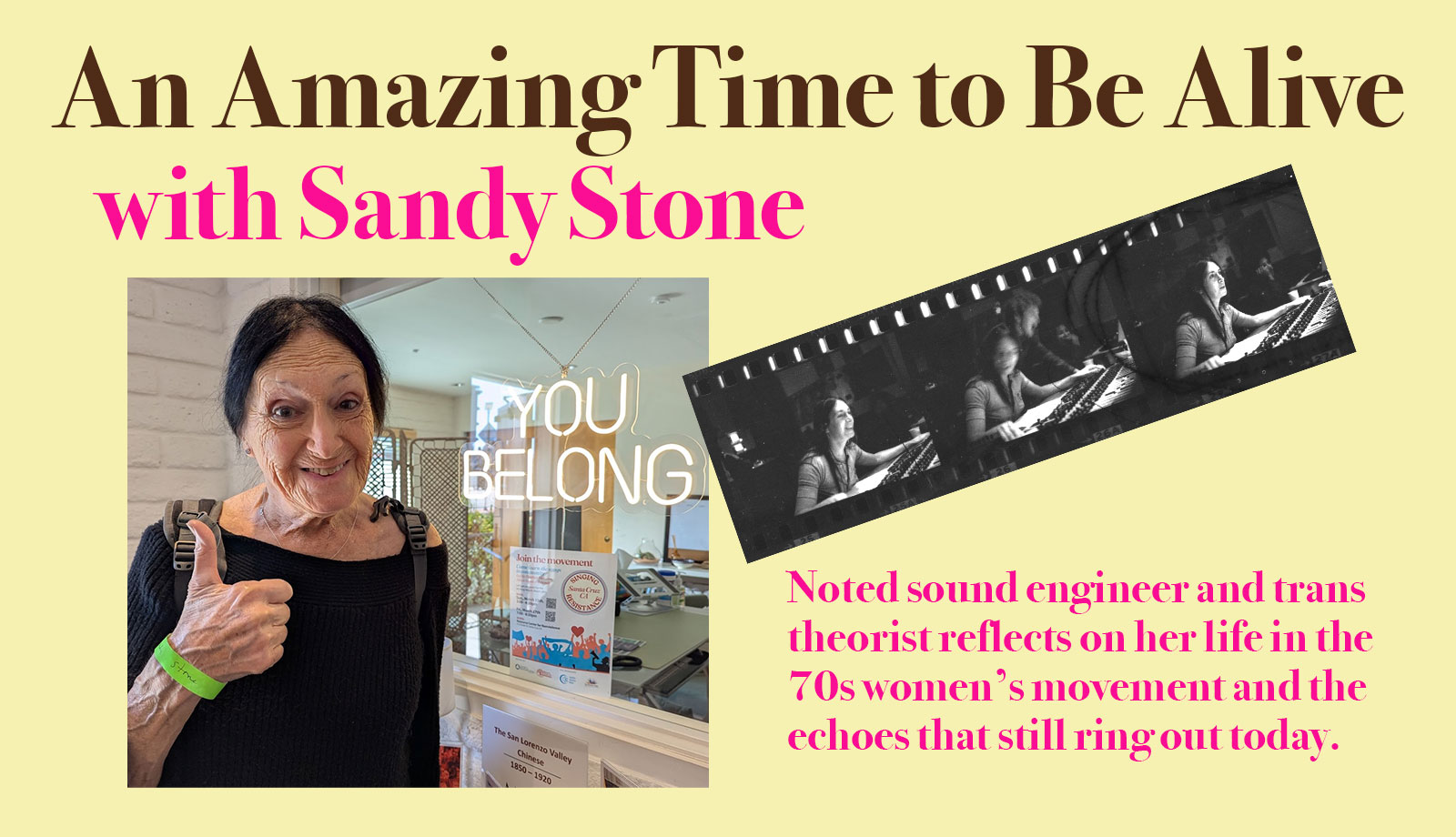


Sandy Stone landed in Santa Cruz, California in 1973, looking for a safe place to transition her gender. The Santa Cruz of her generation, as she describes it, was “weirder by orders of magnitude” than the left coast towns of today. She set up a business, the Wizard of Aud, and went about her life.
But something unexpected happened. Sandy, newly transitioned, was embraced by the women’s community, then hired to be the engineer for the nascent women’s music label, Olivia Records. The transition was wider and deeper than gender. She found “ Sisterhood, comfort, mutual aid, good conversation,” a revitalized career, and TERFs—women whose pain she recognized with empathy, compassion, and a strong sense of self-preservation.
In this conversation, we explore two times of Sandy’s life: her personal experience with the women’s movement and attempts to exclude her, and this modern time, when Sandy says we’re hearing echoes of the same old story when it comes to transgender people. In both periods, women who could be trans people’s allies turned on them, but in this period, their message is being amplified by a political movement “mobilizing disenfranchisement and pain.” [Click for transcript]

Allucquére Rosanne Stone, also known as Sandy Stone, is an academic, media theorist, artist, audio engineer, and computer programmer. A founder of the academic discipline of transgender studies, Stone’s trailblazing work created space for trans scholars to unfold the vast spectrum of gender. Stone first gained prominence in the 1970s as a sound engineer for Olivia Records, the first company to produce and distribute music by women artists.
In addition to her work in art, music, and technology, as an academic and public intellectual Stone continues to provoke important societal conversations. Her groundbreaking 1987 essay “The Empire Strikes Back: A Posttranssexual Manifesto,” not only challenged prevailing notions of gender but also laid the groundwork for discussions on transgender issues in academia and beyond.


Mentioned in this episode:
- 1970s Santa Cruz, California
- Santa Cruz Women’s Community
- AIDS crisis (Note: this link is to a CDC webpage which is currently factual. Please use your discretion on federally funded organization pages, which may now cite non-factual propaganda.)
- The Wizard of Aud
- The TranSisters
- The Santa Cruz Women’s Health Center
- Santa Cruz Women’s Community
- Olivia Records
- BeBe K’Roche
- Berkeley Women’s Music Collective
- Related episode: Two Strange Moments with Writer Joan Gelfand
- Trans-Exclusive Radical Feminists (TERF)
- Sinister Wisdom
- University of California Santa Cruz (UCSC)
- History of Consciousness program
- Donna Haraway
- University of California San Diego (UCSD)
- Critical and cultural studies
- University of Texas at Austin
- Don Norman
- The Glass Cockpit
- New Media
- Plus ça change, plus c’est la même chose
- “Male energy” in the 70s
- Trans women face a lot more hatred than trans men
- Patriarchy
- Marriage equality
- Cynbe ru Taren
- Brexit
- Election of Trump
- Hillary Clinton “basket of deplorables”
- Robert Heinlein
- Margaret Atwood
- The Republic of Gilead in The Handmaid’s Tale
- The Breen office, the Hays office
- The people in Minneapolis
- Arab Spring
- Lambda Legal
- American Civil Liberties Union (ACLU)
- Supreme Court recent transgender decisions
- Law that encourages people to photograph in bathrooms
- Kamala Harris’s support of transgender people
Music:
- “Lonely Blue, Holy Blue” by Patricia Taxxon from the album Ten Skies, 2024
- “Bones” by Pretty Swans from the album Blackbird Nice, 2020 (read more about the artist, Never Angeline North)
- “Strong & Free” by Bebe K’Roche from the album Be Be K’Roche, Olivia Records, 1976
- The broadcast version of this episode also includes “I am Woman” is by Helen Reddy, 1972 from the album I Am Woman, Capitol Records