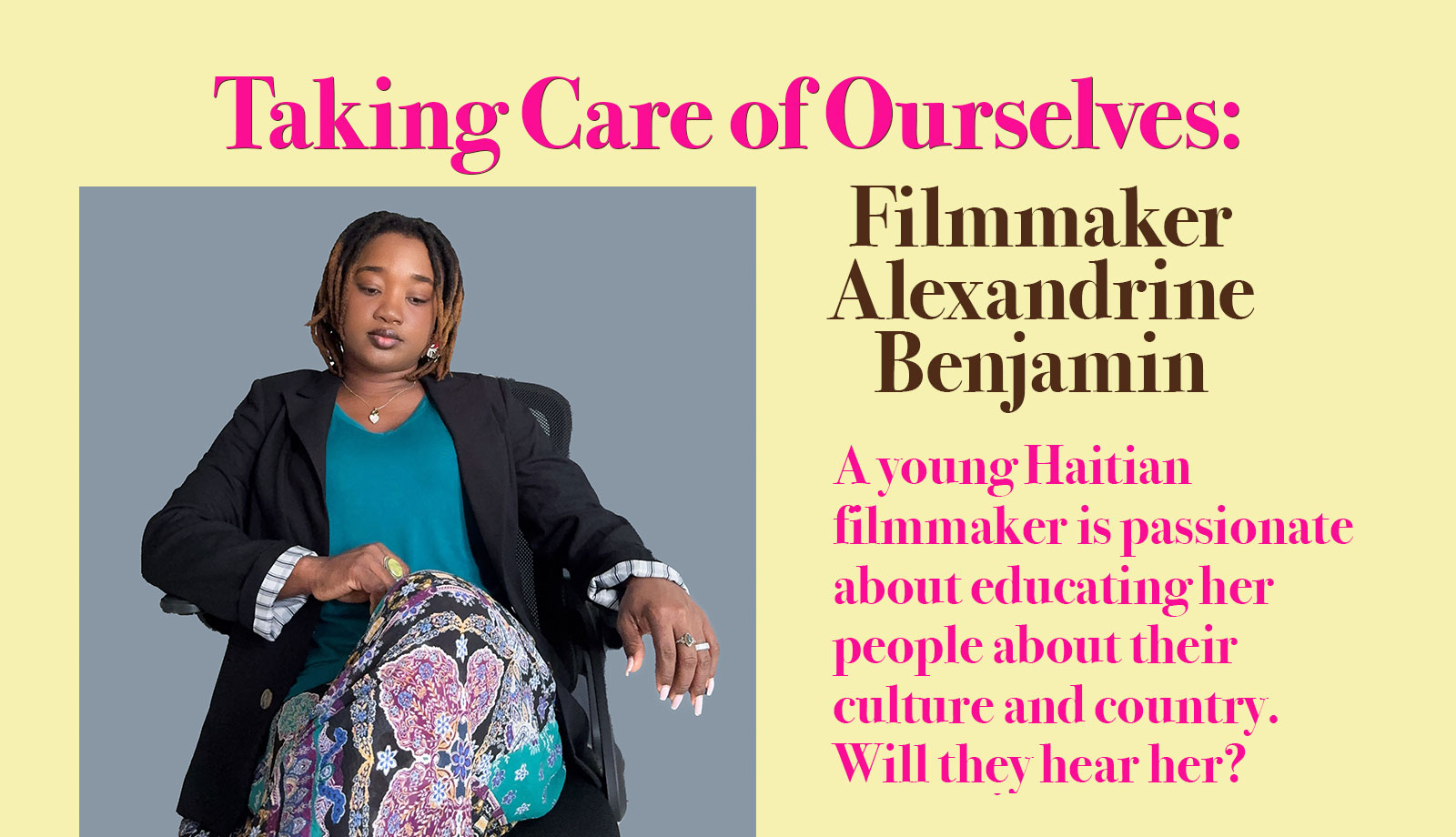
In her childhood, filmmaker Alexandrine Benjamin experienced the struggles of life in Haiti, a country with a troubled past and present. She had to work hard for every step of her education and career. When it came to making her first short feature film, there was no question that she would depict Haiti with love, care, and a deep hope for its people.
It was hard enough to plan the film from Great Britain, where she was studying for her master’s in film. But once she got back home, it was clear that the challenge of making a film in a country where the government is no longer functioning on a basic level was almost overwhelming. Despite veiled threats and demands at gunpoint, this young filmmaker didn’t give up.
“ For the past three years, N Ap Boule has been some kind of therapy for me, allowing me to connect with people. It keeps me grounded, reminding me why I decided to make the choices that I made. It’s very important for me to keep creating content that can impact people’s lives in a positive way. At some point, I’m going to get to where I’m meant to go.”
The result is her film N Ap Boule (“Through the Barricades”), which depicts a couple attempting to get to the hospital so that she can give birth. In our conversation, we talk about the film, about life in Haiti for the most vulnerable, about Alexandrine’s work, and about her belief that Haiti can get back on its feet.
[Click for transcript]
“In Haiti it’s like a cake—everybody is trying to get their part. But we are a nation and we took our freedom for a reason. We should be the one standing for our people and take action in Haiti to change things.”
Alexandrine Benjamin is a Haitian filmmaker. She holds a master’s degree in film production from the University of Greenwich in England. Her works mostly focus on social justice issues such as human rights, gender violence, and insecurity. She recently directed N Ap Boule, an award-winning short film that tells the heartbreaking story of a Haitian pregnant couple looking for a safe place to give birth in the midst of the Haitian socio-political movement “peyilòk”. For more than five years, Ms. Benjamin acted as project manager for Lakou Kajou, an engaging media program produced by the small American media Blue Butterfly which raises awareness among Haitian children about literacy and maths, but more importantly about how to solve problems. The filmmaker is now producing her first feature film “O Negatif”, promoting the full emancipation and inclusion of people living with HIV around the world. At the heart of all her work is a belief that education and empathy are the first steps toward a better future and that cinema can be a catalyst for both.
Credits:
N Ap Boule film outtakes courtesy of Alexandrine Benjamin
The song “Sun Solèy,” originally by Dina B., courtesy of Jehyna Sahyeir
The song “Shishiodoshi” is by Glaciære on Bandcamp
[00:00:25] Alexandrine Benjamin:In Haiti it’s like a cake. Everybody is trying to get their part.But we’re a nation and we took our freedom for a reason, you know.We should be the one standing for our people and take actions in Haiti to change things.
[00:00:48] Voiceover: This is your host, Suki Wessling. The turmoil of social unrest governments in disarray and fleeing refugees is most damaging to the most vulnerable. And many artists, although they are also hurt by the turmoil, use their work to show how the most vulnerable are victimized, attempting to raise awareness and possibly find solutions. Today’s guest was attracted to filmmaking not simply for the sake of art, but more specifically to help her people get back on their feet.
[00:01:21] Alexandrine Benjamin: My name is Alexandrine Benjamin. I am an independent Haitian filmmaker based in San Juan Puerto Rico. I, uh, have a master’s degree in film production from the University of Greenwich, London. I have done some work, in Haiti. My background is really in, you know, kids programming. I’ve worked as a production manager for about five years for that, um, USA company doing kids programming in Haiti. And prior to that I also, I’ve produced some documentaries and, you know, other kinds of content for children and, you know, families as a whole. I, uh, recently completed my short film, N Ap Boule, which is now in, um, distribution. I am currently working as an assistant manager here in Puerto Rico, and sometimes I do, um, freelance work, you know, creating content in Haiti.
[00:02:27] Voiceover: In this conversation, we talk about Alexandrine’s film, N Ap Boule, the plight of pregnant women in Haiti. And we’ll also explore her life and the conditions that led to the creation of the film, social and political unrest, and the unique legacy of colonialism and multinational intervention that Haitians bear.
N Ap Boule
[00:02:48] Alexandrine Benjamin: N Ap Boule tells the story of John and Rose, a modest Haitian couple who embark on a perilous journey during peyilòk solely to find a hospital where they can give birth safely. On their small bike, you know, riding through unpaved roads, they had to face like roadblocks. They are threatened with gun fires and, you know, they had to face so many hardships, but even, you know, despite that, that they persevere.
[00:03:19] But when they finally got into the hospital where the suffering should end, it wasn’t the case because the staff behavior worsen their situation because they refuse to provide them with the necessary care. Um, you know, it’s, it’s, it’s a very poignant story, but it’s authentic. It, it, you know, it reflects our reality back then and even more so today.
[00:03:46] And I have to mention, the film was set during the peyilòk, which is, um, a sociopolitical movement that, um, emerged Haiti back in 2018, I think you know about 4 billion US dollars that went missing. And, um, people wanted to know what happened with the money. So they started a whole movement, and that movement turned into a violent, you know, series of events where people would get gunned down or kidnapped.
[00:04:22] And, you know, people, they, I don’t know, they got how do you say that they– Some people got into the movement, you know, and they destroyed from the within, you know? And um, now whenever you say peyilòk, which is something that people should have been part of, but the only thing they can refer to is violence ’cause that’s what it is. That’s what, that’s what it became.
Peyilòk
[00:04:47] Suki Wessling: What is it like in Haiti during this time besides the, the violence against people, how does it infringe on people’s basic lives?
[00:04:58] Alexandrine Benjamin: You know, in Haiti, I mean, the country is known for a very violent, you know, country. So we have suffered from a lot of, you know, injustice from other nations, you know, people with very bad intentions. So we tend to just stand against stuff very rapidly. But that particular movement, which is peyilòk, is something that for the first time in my whole life, I’ve seen Haitians people align behind a specific thing.
[00:05:32] You know? So the whole country, we had movement in every of the 10 departments and people, they wanted retribution. They wanted to understand what happened with that money, and then suddenly, nobody understood what was happening. You know, because we had some people who, they were, you know, they, they weren’t that in as involved as they were before, and then they started to, you know, just discrediting the, the movement and, uh, it all went sideways.
[00:06:06] And it’s hard because the only thing that we wanted was to, you know, understand what happened to that money. And we thought, I personally, I thought that this was going to be a starting point for us as a nation to get people to deliver what they promise and to, you know, just you know, give report, because politicians elected people in Haiti, they do not report to Haitians, unfortunately.
[00:06:43] And we are not used to ask, you know, like force people to work because that’s what we electing them for. So it was supposed to be rewarding at the end, but we still don’t know what happened to the money.
[00:07:01] Suki Wessling: How did you decide on this film in particular, this storyline? Where did it come from?
[00:07:09] Alexandrine Benjamin: The desire to create that specific film came out of frustration to tell you, frankly. It was winter of 2020 actually. I had been away for a while studying in London and it started to be cold, like very cold. And I do not like cold. So I wanted to go back to Haiti, like spending Christmas with my friends and family.
[00:07:32] But I couldn’t because all of the violence going on would prevent me to. And you know, at the time, several neighborhoods in the capitol were blocked by arm bandits. The road leading to my to Jacmel, my hometown, was closed through Martissant, which is like, you know, a very big region in Port-au-Prince.
[00:07:54] So, you know, I started to vent with a friend, you know, he’s now my husband, about how such action could impact so many aspects of people’s life in Haiti, especially pregnant women. And that’s when he told me that he had written the short treatment for story similar to this and asked if I wanted to develop it. And you know, at the time I was working on my final thesis, the, the subject for my final thesis.
[00:08:21] And I just jumped on the opportunity because I really saw how, you know, the potential because you know, I was studying in London, I know producing a film with the university would have the opportunity to show it to so many in so many places in the world, and I thought, yeah, this is the best way to do it. I can kill so many birds with just one stone and I just jump on
[00:08:43]
[00:08:57] Voiceover: Alexandrine’s first short feature, N Ap Boule, follows a couple in Haiti who are trying to get to the hospital so she can give birth. Previous to the current unrest, any woman who could afford to undertake the journey would’ve gone to the Dominican Republic, which shares the island of Hispaniola. Due to political demonstrations turned violent, however, the DR closed their borders. So Jean and Rose take a harrowing journey on a motorbike through smoke-filled streets, encountering a roadblock, thieves, a gang, and dead bodies before finally securing help from an unnamed young man who takes them to a private hospital. Alexandrine and her team, shot the film in her hometown of Jacmel, hoping it would be a secure enough location.
Shooting the film
[00:09:42] Alexandrine Benjamin: It was crazy, you know, to be honest. And, um, everybody, like the university members, my families, my friends, they all advised me not to go back, like, you know, and to shoot that specific movie. The university, they wanted to let me use their equipment, but the insurance company said, no, no, they won’t allow their equipment to go to such a country with, so imagine me a whole person like going there!
[00:10:18] But, um, you know, I have a lot of friends, a lot of people who believe in me. I also have my former film school. You know, I had very good, um, relationship with them and when I went to them with the idea, they all agreed to support me. I didn’t go back to Haiti until a month before the shoot, so I had to, like work remotely with everybody from, you know, the main characters my team, the head of departments, like director of photography, sound men, um, director of production design product, the production designer. My assistant director, production manager, everybody.
[00:11:01] And let me tell you, those people, they made N Ap Boule.And if you, if, if it weren’t for them, this movie wouldn’t be. Because when I was ready to go back to Haiti, everything was like set. I just had to visit, you know, the locations and had a few, um, we also met with the actors and, uh, we were set.
[00:11:26] But during shooting, things went sideways. I mean, I wasn’t like, it’s not like I was, um, surprised because I know you know what the country was like. That’s actually the reason we decided to shoot in Jacmel, which is the southern part of Haiti. Because most violence was happening in Port-au-Prince. So we thought, you know, shooting in Jacmel. I am from Jacmel. My friends, my team, my crew members, they are all from Jacmel, so we’re gonna be fine.
[00:11:58] But you know, it didn’t happen like that. People, not all, you know, everybody was happy with what we were doing because, um, some people, powerful people in Haiti, in Jacmel, when they see you with a camera, they are afraid that you are going to show, you know, what they are doing underneath. One time a guy came on the set and he pulled out the gun and he said that we had to stop, and I was like, he, I was like, who are you? I had, because he came and asked who is responsible? On for some reason, someone came to get me, from set, so I went out and I was like, yeah, that’s me. You know, I’m studying, I’m producing this short film for my, you know, thesis project. And then, um, it was like, ‘I’m not interested in what you’re saying. I just need you guys to back, you know, just take it. I don’t want you here.’ I was like, but who are you? Because we have permission from, you know, the mayor’s office, from the police department. And he, he was like, ‘I am an authority. I am a chief’, you know, like, like, but I’m trying to get someone to get me my authorizations. He is like, ‘look, lady, I need you out of here.’
[00:13:15] So I just went back to the team and be like, guys, you’re not going to finish it today. I asked him for about an hour to just wrap,he is like, ‘you have 30 minutes’. So. We wrapped up and you know, we just left the scene. And I remember another time we were doing the scene where the tires are being burned, and then a guy came and he was like,’ I, I, what you doing? This is my neighborhood! I govern, you know, you can’t be here without my permission.’ Something like that. And it was crazy.
[00:13:48] And that’s actually one of the reasons we weren’t able to shoot everything that we were supposed to shoot. And in the middle of this, the former president, um, Jovenel Moïse was assassinated. So we had to stop production for about three days.
[00:14:05] And I mean, I wasn’t even sure that we were gonna be able to complete the film because we, we weren’t sure of what was going to happen after that assassination. But my team was like, no, we came too far. We can’t just leave everything and just, no, we can’t. So we stopped for aboutThree days actually. And then we resume production. So yeah, basically, you know, we were able to shoot the essential, but, um, production wasn’t easy at all.
The actors and their roles
[00:14:32] Voiceover: The acting in this film, a fictional drama, is strikingly realistic. The lead actress Ericka Julie Jean-Louis has few lines as pregnant Rose, but her face clearly transmits her stoic perseverance and trust in her husband Jean. The actor Kenny LaGuerre projects calm, fierce resolve, and finally desperation in the face of a nearly impossible situation. For both actors, this is their first film.
[00:14:58] Alexandrine Benjamin: The two main actors were like professional, I’m saying like professional, because they’ve act before for theater, for théatre, but that was their first time for on the screen, like working on a film set. I didn’t do like a proper casting for them because I connected with them while I was in Port-au-Prince.
[00:15:23] But I’ve seen them playing when I was in Haiti at Institute Francais Fokal. Those are, you know, um organizations working in the art field. So I’ve seen them, one of them, Ericka, she’s a singer, she’s a dancer. She is like, she is amazing. You know, I’ve seen her on stage. She is just wonderful. So, um, when I went to her with the idea, she was like, I wanna do it. I want to do it. So I was like, okay. That’s great. And then Kenny also, he, he studied at Précis Conservatoire, I think, he studied acting for theater. And then they agreed to, you know, start the work. So they prepared their, their, characters. And then when I when I went to Haiti, we worked together.
[00:16:06] We stayed at the same hotel. We worked for about two weeks, I think. You know, just really to get to know each other and for them to get the chemistry going, too. Because to me, I mean, for a film like N Ap Boule, which is something that we all live every day in Haiti, I don’t think the acting is really necessary. You just need to get to understand the situation you are in, you know, understand the reality, and then you just let it flow.
[00:16:38] but really, I, I just tell them, okay, so you know, this is where you are, this is what you’re doing. And then I just sit there and look how they act and then if I have something to adjust and they just do.
[00:16:55] Voiceover: I was particularly interested in the character who finds Jean and Rose walking on the street, their motorbike stolen. This unnamed character, who has no lines, strikes a strong contrast with the others that Jean and Rose encounter. While Jean argues with and eventually threatens the hospital staff, this young man in dreadlocks cares for Rose who has now been laboring for hours. Alexandrine explains that as an American, I missed an important social cue about this character.
[00:17:26] Alexandrine Benjamin: You know, over the years when I speak to people, when I attend screenings and people are asking questions, I’m amazed at how, you know, everybody interpret his character in their own way. You know, they’re trying to give it a meaning different than what I heard, you know, during another screening, stuff like that. But, um, I wanted to show two things with this particular character. You can see that he has dreadlocks. Dreadlocks is something that is viewed in a very bad way in Haiti.
[00:17:57] So the moment that I see someone with dreadlocks, you are automatically a bad person in their eyes. I actually just last Monday, I think I saw a piece that, you know, um, a news, um, they produced that, um, piece about the way that people see people with dreadlocks in Haiti and how some people wouldn’t get a job accepted for a job because they have dreadlocks.
[00:18:25] Suki Wessling: Can you give us a little context, because of course, Americans right now are listening and thinking, wait, you know, almost everybody in Jamaica has dreadlocks. Why is it such a signifier of someone, you know, someone so awful in, in Haiti? What’s the reason behind that?
[00:18:43] Alexandrine Benjamin: You know, I came to understand that we are educated to not appreciate what we are, who we are. And, um, I mean, I know some people, some bad people can have dreadlocks, but some, I mean, many bad people do not have dreadlocks, you know. So I, I don’t understand the whole reason. I mean, I understand some, maybe they’ve experienced, you know, bad people with dreadlocks, but that doesn’t mean that everybody that has dreadlocks is bad.
[00:19:15] Suki Wessling: Mm-hmm.
[00:19:16] Alexandrine Benjamin: But, um, you know, it’s a, another show for another time. We Haitians, Black people, we need to work on ourselves. We need to learn how to appreciate who we are, just not. Okay. That’s a show for another
[00:19:33] Voiceover: You’ve been listening to Haitian filmmaker Alexandrian Benjamin. Talk about her first short feature, N Ap Boule. Coming up, we talk about her upbringing and education, and we get into that ‘show for another time,’ exploring Haiti’s past, present, and Alexandrine’s hope for its future.
Segment 2: Life and education
[00:19:50]
[00:20:17] Voiceover: This is your host, Suki Wessling. I’m speaking with young Haitian filmmaker Alexandrine Benjamin, who has released her first short feature, N Ap Boule. I asked her to talk about her life and why she became a filmmaker.
[00:20:30] Suki Wessling:
Growing up in Haiti and becoming an activist
[00:20:32] Alexandrine Benjamin: I came from a family of, three children. I am in the middle. I have, but we are all half sisters. You know, our fathers was, they were never there, you know, so my mom, who she educated us, you know, the way she could. She’s a very strong woman. I mean, I’ve seen my mom doing so many things. I mean, as an adult now, I just don’t understand how she managed to do all of this, but she did it.
[00:21:07] She managed to educate all of us. And um, in the middle of that was, um, the fact that we somehow helped educating ourselves as well, because she was traveling often, you know, trying to go buy stuff so that she can always sell, stuff like that. And we would stay at home and, um, I’ve witnessed a lot of injustice. I mean, I suffered some, but, uh, people in my neighborhood, because we were, I mean, I was born in Port-au-Prince, but after– there was what we call a, um, coup d’état from President Aristide in 2000. So Port-au-Prince was like crazy and my mom took us all to Jacmel despite her husband, you know, saying not to go. So she went anyway, and for that reason, the husband decided, which is my stepfather, he, he decided, you know, that he wouldn’t support because my mom, you know, just
[00:22:18] So we, we, we were there and, um, you know, in a whole year that that’s how people live in Haiti. We have like big courtyard with many different households and, um, I witnessed so many injustice that I had to, I became I don’t know, I developed that rebellion aspect of not doing exactly what people tell me to do.
[00:22:46] Like I, I become an adult very young, okay? So, and um, you know, I thank myself for that because I, am certain if I wasn’t that way, I wouldn’t be who I am. Because my mom, she is very conservative and she didn’t necessarily have the background to understand how, because she was doing so many things, you know what I mean?
[00:23:14] but besides I don’t think she got exactly that educating children doesn’t take just giving them food or sending them to school. You know, it takes really more than that. So I had to figure this out by myself and try to go places, to speak to people, to read, to do so many stuff so that I could help with myself, with my mom working.
[00:23:43] So, um, I guess that’s how I got into, activism, you know, because, um, there was a lot of beatings, you know, husbands beating their wives, parents beating their kids so hard. It was very sad, frustrating at the same time. So, you know, I started to find a, you know, I found a purpose, you know, just make myself useful to something.
[00:24:11] And, uh, yeah, I got into activism and later I got into filmmaking because, you know, people, they like to ask me this question, how did you get into filmmaking? Like, it’s not, I didn’t ‘get into’ creating movies because it, you know, I wanted to do art. I wanted to help, and I just realized that film making can help with that and I decided to do making.
[00:24:36] Suki Wessling: I wondered if, if you’d be willing to talk about one particular thing that you remember. You said that, that a lot of injustices led you to activism. Can you talk about one situation in particular that really sticks with you, that you feel really influenced you?
[00:24:53] Alexandrine Benjamin: There was that couple, they went a room from my mom. They weren’t married, but they were together and they have a child. And then the woman, she is, she is a very nice woman, you know, she would stay at home, prepare food for her husband when you know the guy is back. And every single day the guy’s back, he just keep beating the, I mean, for no reason. He would get his, how do you say, ceinture, let me find out. This is very I need to
[00:25:30] Suki Wessling: His belt.
[00:25:31] Alexandrine Benjamin: belt. Thank you.
[00:25:32] He would help Get his belt, you know, and start beating the lady for no reason. And she would cry so hard and my, my heart was But the guy, he was, he was like giant. There wasn’t much I could do, but the worst part was the fact that there were other people in the area. They would just stare.
[00:25:59] Suki Wessling: Hmm.
[00:25:59] Alexandrine Benjamin: I mean, in our culture, I mean, maybe some things have, you know, have changed, but back then your husband was allowed to beat you. So if someone finds out that you are getting beaten by your husband, their first question is, what did you do? You know, like they’re trying to justify the reason why you’re getting beaten. And I was like, this isn’t, I mean, that woman is not a dog. She isn’t supposed to get beaten because whatever she did, she just doesn’t deserve that, you know?
[00:26:39] So, I started to get involved with, um advocacy organizations working with gender equity and stuff like that, trying to educate myself and then go back to my community and try to, you know, talk to people, way older than me, you know, but trying to help them understand that, okay, so if something is happening, you know, maybe you can try to, you know, speak up, you know, like have a conversation with that person to understand, but that, you know, your wife isn’t like some drum. You can’t keep beating your wife like this, you know?
[00:27:13] So this really stayed with me for a long time because it wasn’t like, um, a situation, it, it, it’ll happen often, you know, with in different household. But it was very common. And, um, I, you know, I wanted to help. I don’t know if I helped, but, uh, I, I know I, I, I spoke to a lot of people.
[00:27:37] Some of them wouldn’t listen to me, but I know that particular lady, she, um, she fleed it out. She, she, I don’t know where she went. Oh, I heard she went to DR. I, I left that place for a while. When I came back, she wasn’t there. They told me that she went away and gave messages and I was so happy for her because I know this can’t be good now.
[00:28:01] Suki Wessling: Mm-hmm.
[00:28:02] Alexandrine Benjamin: Yeah.
Haitians need to see themselves in a different way
[00:28:03] Suki Wessling: Yeah. You mentioned something about Haitians need to start seeing themselves in a different way. And you know, the country has a very long history starting with, with Columbus and, and the colonialism and the various big powers around the world, France and the US mostly, trying to exert control and, and for a large amount of the history of the people of Haiti, they’ve been controlled by someone.
[00:28:41] What do you think needs to happen in the culture to help people learn about themselves, learn about the value of their culture and the value of themselves as people?
[00:28:55] Alexandrine Benjamin: Well, one thing is that we need to stop studying or educating kids with books that are from outside. You know, because more schools in Haiti, I mean, we have a lot of traditional schools, they have books that came from outside and that is what they use to educate children. And, um, the culture that we are being taught is not really authentic. So if we don’t really know who we are, if we don’t get the authentic version of the Haitian history, it’s gonna be really hard, you know, to appreciate who we are and where we came from. And just last month I think there was like a big, um, you know, discussion on the internet about an economist who said something about, um, uh, or you have to stop, um. How do, how can I put it? Should I talk about that? It, it’s complex, you know.
[00:30:00] I mean, the way I see it, he was, he met the fact that we need to do something and stop relying on what our ancestor did. You know, because it was 1804. So we need to stop doing something for ourselves. And people weren’t happy at all. They thought that he meant that we need to forget about them and stuff like that. But in fact, Haitians, it’s a very complex nations, you know. Our past, I believe, interfere with, you know, our daily lives and we don’t even realize it, you know, some kind of behaviors that we may have, for example, not trusting each other.
[00:30:43] This is a very big issue in Haiti. We do not trust each other, and you may, you certainly know that any good relationship start with believing, trusting each other. If, if I don’t trust you, I can’t have a good collaboration with you. You know, we, there is nothing good we can do because we are still waiting for when you, you know, you’re gonna do something that will like hurt me. But because we’ve been hurt so much in the past, how do you get that out of the Haitian mind? Because we’re not even aware that we’re like that. You know, it’s not even a thing for us. And we, I mean, I think every Haitian would, we should have, I mean, we should include therapy as part of the curriculum in ha you know. Because we are so ill and we do not know that. We need, we need treatment, we need to treat ourself, we need love, you know, we need understanding from each other. And, the amount of violence that is going on in Haiti right now came from that, because we suffered so much.
[00:32:02] From a tiny part of people who believe that they are the one that that Haiti’s profit, everything is theirs, and those people with their guns, to me it is their way of reacting to that injustice. And now that they have vested power, they do not wanna hold back. And I mean, miracles exist, that’s a good thing, because where we are, I’m not sure how we are getting out of it.
[00:32:44] I’m not sure.
[00:32:45]
Going to Britain
[00:32:48] Voiceover: I asked filmmaker Alexandrian Benjamin, what led her to study film at the University of Greenwich in Great Britain, and then what the experience was like to go from Haiti to England.
[00:32:59] Alexandrine Benjamin: Well, it was in the middle of COVID-19 I remember at the time I was working at the Blue Butterfly with the University of Uni in Haiti, and um, I wanted to upgrade myself, you know, because I felt like I had some holes, you know, I could and I could use some more, um, how do I put it? Skills? I saw myself doing like way more because I had a taste of how filmmaking could impact people’s lives in Haiti. And I thought the more skills I have, the more I can help. So, um, I decided to do a master’s degree. I wanted to go in the States, you know, to begin. But the process was very complicated because, you know, they all wanted me to, to start from scratch, like do a bachelor’s degree, four years because, um, they wouldn’t accept my, um, two consecutive years of studying Atin Institute. And it was a lot because four years outside, you know, and I was the one financing my studying.
[00:34:10] I discovered that in London, they had a one year master’s degree program. So I thought, okay, know I kind of like the kind of movies they make, you know, and I like their style and if they are going to accept me because I had five years. So when they added that, you know, those five years to my two consecutive years, I was, you know, but they asked to see my curriculums, my past grades, stuff like that. And then before I knew it, I I was accepted at three or four universities. And then I, I, you know, I chose to go to Greenwich, because I, like, they have a beautiful campus, you know, but I like their program, because while doing, um, a masters degree in production, you get to learn to take cinematographic classes, sound classes, editing classes, like directing classes. I loved it, so that’s why I decided to go there instead.
[00:35:12] But I can’t say that I enjoyed the experience fully because of COVID-19. And, uh, first to start. It was so, so hard to get there because they don’t, you know, Great Britain do not have a consulate in Haiti. So I had to go get my visa in DR. I had to stay in DR for about a month until they could make a decision and by then school had started in Great Britain, so I missed a couple of classes and when I finally get the visa, I went back to Haiti to travel to London. I had to quarantine for two to three weeks I think.
[00:35:53] So I missed so many things. And then when I was finally able to go to school, I didn’t under understand a thing. And I was like, I don’t know what I’m gonna do. I spoke to my uncle, he’s like my father, and I was like, I think I’m go I’m going back to Haiti. I can’t because you know, their English is different than, um, American English. And everybody wore masks, face masks, so I couldn’t read their lips. So I was like, I don’t understand what, what am I gonna do? I’m not gonna pass those classes. Stuff like that. And then, you know, after two or three weeks, I, you know, got back on my feet and it was alright. You know, I had some good support from the team there. You know, I was the only Black student.
[00:36:40] Suki Wessling: Wow.
[00:36:41] Alexandrine Benjamin: you know, in the class. So it wasn’t fun at all. And um, it seems that the area where, you know, where I stayed in Greenwich there wasn’t a lot of Black people, so people would stare at me on the streets. I’m like, am I in, you know, 1018, what’s going on?
[00:37:00] Why are these people looking at me? Why at me? Like this, you know, it was… but I was focused on what I came there to do. I went there to study and I was like, this is what I’m, I’m going to do. So I focused, I passed my classes and then I couldn’t wait to go back to Haiti. After I finished my classes, oh, I went to Haiti to shoot. They wouldn’t agree, but they finally accepted for me to go back.
[00:37:31] And then I had to go back. I still haven’t graduated. I mean, I, I have my, my diploma, my, my, my degree, but I wasn’t able to attend the ceremony, the graduation ceremony, because I came into Puerto Rico to get my visa and I couldn’t get it. After two months, I had to wait. And then finally they told me that I was supposed to send my passport while I was waiting on them to ask me for my passport. So I miss the ceremony.
[00:37:56] Suki Wessling: Oh no.
[00:37:57]
[00:37:58] Voiceover: We are speaking with filmmaker Alexandrine Benjamin. When we return, we’ll talk more about Haiti, about immigration, her upcoming projects, and about what Alexandrian took away from the experience of making her first film about the country she cannot currently live in.
Segment 3: A message for the future of Haiti
[00:38:13] Voiceover: This is your host, Suki Wessling. Filmmaker Alexandrine Benjamin’s first film is not autobiographical, but she relates how the experience of making the film during such a difficult period for her country has touched her personally.
[00:39:32] Alexandrine Benjamin: Ap Boule is, it’s not just a project. I think for the past three years, N Ap Boule has been some kind of therapy for me. You know, allowing me to connect with people every now and then.
[00:39:45] And it keeps me grounded, you know, reminding me why I decided to make the choices that I made. And that even though it can be hard now, you know, but at some point, I’m gonna get to where I am. I’m meant to go. You know, I, I, it’s very important for me to keep creating content that can impact people lives in a positive way.
[00:40:13] Even though now I’m, I cannot fully, you know, I cannot exactly do what I’m supposed to be doing, but you know, things will change.
Reflections on being Black outside of Haiti
[00:40:23] Voiceover: I asked Alexandrine to reflect on the experience of being a Haitian, outside of Haiti.
[00:40:29] Alexandrine Benjamin: You know, um, Haiti is a Black nation. I mean, we all used to see people with different colors, which they adore. Haitian loves strangers for some reason. You know, they just love them. I have traveled before going to the UK, you know, I, I studied to travel, I think in 2015 I went to, um, Canada, which is, um, they have a, you know, you know, interesting, amount of Black communities. I went to the States for, you know, maybe five, six times before I– and it wasn’t that different because I was able to see people with the same color as me and stuff like that. I got into Britain, it, no, it wasn’t the same thing at all! And I’ve heard, I mean, I’m told that there’s, um, a community of African in, you know, in Great Britain. And I, I, I didn’t see a lot of them. And people the way that, I mean, that’s when I realized that something is wrong because they have a way of looking at you to make you feel like, are you sure this is your place? Is that, is that where you’re supposed to be? You know, and being at a school where not a lot of people would look at me like, are you lost or something? And I’m like, is that what people, you know, Black people are going through, you know, on a daily basis? And. I’ve suffered from so many, um, acts of racism in London. I couldn’t wait to just go back to my country because in my country I don’t get judged because of my hair, texture of the, my of my color. You know what I mean?
[00:42:19] And I, I remember, you know, until now that the first time that students. In, you know, in my class started to hang with me was after my first presentation at school. At school, I made a wonderful presentation and the teachers, they were like, amazing. I did, you know, that I did like a wonderful job.
[00:42:45] And that’s when my classmates, they started to look at me. Maybe even realized that I was there. Oh, there was someone there. You know what I mean? And, um, they started to finally invite me on projects because at first they wouldn’t even get into the same team as me. You know, because it, for some reason, when you are Black, they automatically associate you with being dumb.
[00:43:11] You know, you synonym of being dumb for some reason. So, um, I don’t think it’s fair at all. I think everybody should get a chance to, you know, people should be open to experience each other, you know what I mean? Not judging them because of their hair or their color or, or what they wear, stuff like that.
[00:43:30] I mean, maybe it, it is worse in, you know, in the UK but in the States, I think a lot of, I think they have a very diplomatic way of, um, expressing themselves. So, um, you can’t just look at them and understand what they are feeling. But, um, I think a lot of Americans, they do prioritize their, how can I put it? They are, you know, used to people with different colors, but some people this is not enough for them, you know? They are not that easily able to mix themselves up with, you know, people from other nations and especially Black people. And I I feel like the darker you are, the more you are getting response because the very white people, they do not like people with that yellow color. You know, for them they are not white enough. And the yellow people, they’re like, huh? You’re like Métis. You know? So I mean, the big lessons for Black people at the end, I mean, what, but, um, I think, you know, whether it’s Great Britain or America, Black people can feel like they’re not home, even though, especially America, America is built on, you know, immigrants back, you know what I mean? It’s, it’s the work of a whole community, people from everywhere. But they still claim the land as theirs and just theirs, you know, their own. And I, I mean, I won’t get into this, but um, if anybody who knows history, we know whose land it is like, please.
Haitians need to save ourselves
[00:45:30] Voiceover: The treatment of Haitians during the 2024 US presidential election was, I struggle for the right words to describe it. I felt mortified even bringing it up to a well-educated, thoughtful, talented person I view as a citizen of the world. But when I asked her about it, I admired how, instead of focusing on the American political freak show, Alexandrine Benjamin focused instead on what she believes is healthy for her own people.
[00:45:58] Alexandrine Benjamin: Well, I’m not, I’m not very deep into politics, really. But, um. What I do know is that immigration and the different demographics are very complex and there is a lot of history when it comes to immigration worldwide. And um, most of the issues that arise on immigration in general is the fear of potential change. And there are not, you know, and, um, for some reason, Haitians, they they get fooled easily, you know what I mean? And, um, they can’t understand. I mean, they feel like there will be some kind of savior coming to save them when we are supposed to save ourselves. I mean, I know that, you know, some of our policies or a lot of chains are being pulled. You know, in Haiti it’s like a cake. Everybody is trying to get their part, but Haitian shouldn’t let the political state of another country impact our country the way it is right now. Because we’re a nation and we took our freedom for a reason, you know, so. We should be our primary support, you know. We should be the one standing for our people and take actions in Haiti to change things, you know?
[00:47:33] So right now I’m not gonna get into the part where they got used because they’re all adult. If you are able to vote in the us, you’re an adult and, um, if you don’t have the basic understanding of politics or why somebody would want you to vote for them, well, you shouldn’t be voting. You shouldn’t be out voting. But one thing I do know is that the fight to get Haiti back on its feet is in Haiti. I mean, I’m not saying someone cannot fight outside. You can fight outside, but the actions that you are taking, they have to have impact in Haiti. So what is going on in America right now is that the administration is trying to protect their country. I mean, you know, it’s a little bit more than that, but, um, they have a right to do that. We as Haitian, we have a duty to make sure that our country is livable. Is that a good word? Do you understand livable, like where people can live their lives fully, where, I mean, work in a way that haitian can stop running. We’re running. We’re running. We, you know, one day we’re in Chile. One day we’re in Dominican Republic. One day we’re in Mexico. We need to get to a point where Haitians can live in Haiti safety. When, where if we are told to leave, we can leave. Without any fear and just go back.
[00:49:22] I know right now a lot of people, including myself, cannot do that. Just yesterday, they gangs took Arcahaie, so it’s little by little. So when you know that your life is at stake, it’s not an easy decision, but we need to start acting to preventing. Including myself. I mean, how do take an action that can make a difference. You know, our focus should be on the political situation in Haiti, not the US.
Current projects
[00:49:52] Suki Wessling: I wanted to give you a chance to talk a little bit about the project you’re working on now and what you hope it will be and, and who you hope will see it.
[00:50:02] Alexandrine Benjamin: Right now I am working on a couple of projects. One of them is, um, O Négatif, this is, um, a feature film, my first feature film that explores the impact of, um HIV on people’s lives but mostly the way that they are seen by others in their community, in their family. And as you know, um, HIV is having a big impact on the entire world.
[00:50:29] And, uh, a lot of people see it as some kind of disease that can, you know, that is so easy to just get. They tend to, look at people, some, you know, some kind of way to make them feel bad about themselves. And uh, so yeah, we wanted to address that, but really address it in a way that people do not feel like they are watching something about HIV.
[00:50:57] It’s giving them that feeling that HIV is just a disease. It’s like someone who has, you know, just a cold or a fever and that they are still a human being. They have their place in the community, in society, and for those people to, to act, you know, that way, you know, to just keep growing because it’s not the end of life.
[00:51:20] And you know, with science there has been a lot of, um, progress so people can now they, you know, if they start taking medication at a very early stage, there is, you know, a way to have the virus completely disappear from their, um, the blood, their system, if I can put it like that. So, yeah, so that’s it for O Négatif.
[00:51:41] And then I’m also working on a mini episodic project about immigration and, uh, you know, the way that a lot of people feel like life is going to be so easy when we’re not in Haiti, for example. But it’s not always the case. And our people who immigrated, they don’t always say the truth about the kind of life they are living outside of Haiti, in the States, for example.
[00:52:09] And, uh, so I wanna, you know, produced these episodes in the perspective of a child, because unfortunately, most of the times the children are the ones who suffered the most, you know, from their parents’ action. So they didn’t make the decision, but now they are paying for it. So, so there’s that.
[00:52:27] And I’m also working on a documentary about Sabina Carlson. She was, um, a humanitarian, a humanist, if you can call it like that. She died very young with the cancer, but she was involved in Haiti during, um, you know, the earthquake back in 2010. And she, she visited, she stayed there, she learned Creole and she started a bunch of movements with her husband.
[00:52:56] And, you know, she passed in 2022 and now we’re doing a project so that her legacy really can stay alive.
What Alexandrine Benjamin wants Haitians to take away from her work
[00:53:03] Voiceover: Alexandrine Benjamin’s short feature is now being distributed in the United States, but her focus is on her own people in Haiti. I asked her what she hopes viewers will take away from watching the film.
[00:53:14] Alexandrine Benjamin: Well, with N Ap Boule particularly my main message for Haitian with that film is that we need to think about the impact of our actions before we take them. I know we’ve been suffering for a long time, but that doesn’t mean that we need to hurt each other to get what we need. I’m certain there is another way to do it other than killing each other and that we have the responsibility, take Haiti back on its feet. And if we do not think of our actions first, this isn’t gonna happen. And people will keep using us, you know, pitting us against each other for no reason. And at the end, we are always going to be the loss. It’s gonna be our loss, not theirs. You know, when we ab adopt, when we kill, when we burn, it’s our own people.
[00:54:12] Those people giving us guns, you know, telling us what to do, most of them, their children do not live in Haiti. They do not live downtown. So they are watching the smokes from up high. We need to be taking care of each other. No one is gonna do it for us. No other nations, not the United States, not Canada, not France. We’re responsible for ourselves and we need to act like that.
[00:54:42]
END of interview
[00:55:25] Voiceover: Thanks to filmmaker Alexandrine Benjamin for sharing her life and work with me. You can learn more at alexandrineeb.com. The song Shishiodoshi is by Stevia Sphere on Bandcamp. The song Sun Soley is originally by Haitian singer Dina B., and this performance is by Jehyna Sahyeir. You can find links in the show notes at Babblery.com.